
Rwanda
Gacaca Courts
Post-Rwandan genocide, the international community established the International Criminal Tribunal for Rwanda (ICTR) to promote restorative justice through the Gacaca community-based traditional court system to tackle the problem of a destroyed judicial infrastructure. The communities would identify the victims and perpetrators, leading to a public trial in the villages where the crimes occurred. Both people would speak, and confessions would lead to shortened sentences. The judges, chosen by the local people, would deliver the sentence leading to a punishment of either imprisonment or community service with the goal of promoting reconciliation. The Gacaca Courts aim to repair harm, heal victims, and reintegrate offenders through a community-based process to create a restorative justice. In this case, success is measured through reconciliation, restitution, and reintegration. The Gacaca Courts faced many challenges, such as concerns of the system being controlled by the Tutsis or the “winners” making this system unfair, or the slow process due to the complex process of electing a judge, finding the witness and suspect, leading to small amounts of cases advancing.


The Gacaca courts completed close to 2 million cases, with the majority of the cases, 67% of them, being crimes against property, and 33% being crimes against people; of that, 3% were deemed most serious. The likelihood of a guilty verdict was the highest at 96% for crimes against property. High-level offenders would get longer prison sentences, often decades or life, while low-level/property offenders often received community service, instead of prison time. Confessions played a large role in the outcomes of the court cases, as those who admitted to their actions were more likely to have their community service or part of their sentences converted to community service. This incentive encouraged those who were accused to participate in the court, helping it run more smoothly while victims were able to receive closure.
The Gacaca Courts were successful in conducting a quick trial, as with the amount of cases (close to 2 million), traditional systems were incapable of handling such a volume of cases, which reduced the populations in prisons, making it a more humane condition for all. In addition, these confession systems allowed information to be revealed to victims and encouraged acknowledgment of wrongdoing, leading to a more restorative system in which victims could understand the full scope of the catastrophe. However, this also leads to some false testimonies as some perpetrators may confess strategically or lie to obtain a lighter sentence, which complicates the reliability of these truth-tellings. In the short run, this court system helps reduce the large caseload and achieve closure for victims; however, the fairness and consistency of accountability may be affected.
Authoritarian Control
The RPF (Rwandan Patriotic Front)’s post-Rwandan genocide peace efforts were unique due to their authoritarian control of the state and the people, forcing peace into the country. Through intimidation, manipulation of the electoral ballots, and Rwanda’s high tolerance for government control, the RPF was able to maintain power for over 30 years. Using a top-down approach of conflict resolution, the RPF filtered all media, information, and personal experiences to better fit their own narrative of the Rwandan genocide. By rewriting the history and the truth, it forced both the Tutsi and the Hutu populations to be compliant with the government, creating a seemingly peaceful environment. While from the outside, Rwanda seems to have achieved peace, many underlying problems were left unsolved due to the lack of addressing these grievances; the issues were all swept under the rug.
The authoritarian control imposed on Rwanda proved effective in ending conflict, but it does not fully solve the underlying problems due to the lack of addressing these grievances. With the new administration, all issues on ethnic labels were removed, sweeping the conflict under the rug. This makes it difficult for peacebuilding to occur, as these problems are not talked about. Rwandans affected by the genocide have no closure, leading to continuing issues between the two ethnic groups.
Top-down Approach
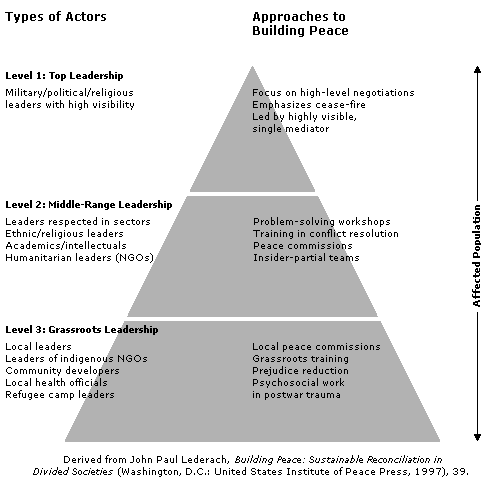
This chart represents the top-down peacebuilding approach, where the leadership at the highest level has the most control. At the top of the pyramid are the executives, including presidents or national leaders. They use executive information systems to monitor key indicators, the peacebuilding process, and support and pass specific decisions. The senior managers use decision support systems to evaluate risks, compare different options to design plans to successfully implement working and work with other organizations or agencies. The middle managers use management information systems to oversee the progress and generate reports. In peacebuilding, they would manage specific programs and track the outcomes of the initiatives and plans. The workers are considered to be at the bottom of the pyramid and are the frontline, or people who execute the plan in action. Through using the transaction processing systems, they deliver the services, conduct dialogues, and are the people who implement plans set by the executives.
Post-Rwandan Genocide, Rwanda used a top-down approach to rebuild the country. At the top of the pyramid, government leaders and executives were responsible for creating laws and policies focused on reconciliation, justice, and recovery nationwide. At the bottom of the pyramid are the frontline workers and volunteers who carried out the plans created by the government. This can be seen in ways such as delivering aid, collecting data, and helping communities firsthand post ethnic conflict. Through the use of a strong top-down peacebuilding approach, Rwanda was able to organize large-scale recovery efforts to help the country.
Database for Family Reunification
The International Committee of the Red Cross (ICRC) created a database to help reunite children who were separated from their families during the Rwandan genocide. From 1994 to 1997, after the mass displacement and the large numbers of Rwandans who had fled to protect their lives, many children were separated, making this reunification process a humanitarian priority. Agencies registered children who were separated from their families, and the families requesting to trace their child into one database with their names, origins, and family links to allow for the system to match children with searching relatives, track movements, and coordinate between different agencies. Over the three years, with more than 119,000 children registered, approximately 57,000 children were successfully reunited with their families. While this was proven helpful and useful in reuniting families, it proved most valuable when the population stabilizes, and cases become more complex, allowing the database to support long-distance tracing, rather than during the initial emergency phase when reunifications could occur locally without the database.
This form of peacebuilding is effective as it successfully restored families and rebuilt the communities. Having a centralized database, where all information was organized, created an effective network that allowed agencies from around the country to use. While this database was ineffective during the initial rapid response phase, it became increasingly valuable and useful as the population stabilized and reunification became more complex. This database was also extremely successful due to the localness and addressing of the problems, rather than creating policies that may not exactly help the needs of the local Rwandans. Overall, the database created demonstrated long-term success with humanitarian efforts and cooperation post-conflict.


